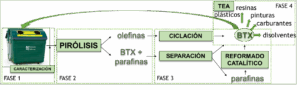
In the PIROPLAX project an integral technology based on pyrolysis has been developed for chemical recycling plastic waste that is hard to separate. An improvement in the plastic recyclability rates contributes favourably to reducing dumping and lowering dependence on fossil resources because it reuses plastic as a raw material. When mixtures of plastic waste are pyrolysed a stream rich in benzene, toluene and xylene (BTX) type aromatic compounds is obtained that can be used as precursors for new plastics, resins, and solvents. The operating conditions that guarantee maximum selectivity for making BTX, like particle size, temperature, heat ramp, atmosphere, and residence time, have previously been identified.
The process also includes intermediate separation and catalytic treatment stages to maximise the BTX stream through transforming other products that are less interesting for this case: olefins and naphthas that are transformed into BTX by ring-closing reactions and catalytic hydroreforming, respectively. The final crude from pyrolysis is collected and characterised to evaluate its quality, and subsequent refining and purification (by distillation) needs for how it will be used are determined.
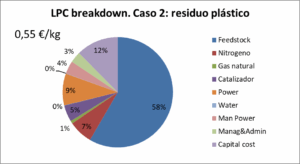
Based on the yields obtained in the project, the technical-economic viability of the process has been evaluated for scaling up to a commercial/industrial level, using a model plant with a 45 TPD daily capacity as a reference. That capacity would handle a third of the plastic waste collected annually by the residents of Navarre, which would be 37,000 tons of plastic waste processed a year.[1][2] For this plant the estimated CAPEX is €19 M, the annual operating costs are €10 M/year, and the cost per ton of BTX stream produced is €511/t. Those production costs would be below the virgin streams of BTX mixtures, which oscillates around €650/t, although it depends on the price of a barrel (~$60/barrel). The different parts of the itemised LPC (levelled production cost) shows that the highest impact on the production cost is acquiring plastic waste. Investment in the plant would be 12%.
[1]Plastics Europe Plastics 2020 situation [website]: https://plasticseurope.org/es/wp-content/uploads/sites/4/2021/11/ES_Plastics_the_facts-WEB-2020_May21_final_updatedJuly2021.pdf [Último vistazo a 08/04/2025].
[2]WASTE INVENTORY SUMMARY Office of Waste Prevention and to Promote the Circular Economy Government of Navarre