In a world that is more and more digital, technologies that make it possible to manufacture flexible, transparent and efficient electronic devices are fundamental for innovation in sectors like automotive, consumer electronics, solar energy or medical devices. In this context, the EleSpray project has focused on developing new manufacturing methods for the following flexible electronic products:
- Transparent conductive surfaces using ultra-thin track patterns that are practically invisible to the human eye for use on touch screens, solar panels or electronic interfaces
- Homogenous conductive coatings that can do things like heat surfaces, and that are very useful in applications like integrated heating systems or electronic protection
To achieve that the project has explored two cutting edge technologies:
- Atomisation of conductive inks using photolithographic masks to create very precise patterns (figure 1): New inks and methods have been researched to improve adherence, uniformity, and transparency.
- Electrohydrodynamic (EHD jet) Printing: With this innovative technique ultra-thin lines of ink can be printed without requiring physical contact or masking. The equipment needed for printing has been built (figure 2), and our knowledge of the characteristics of inks was deepened to find ones suitable for high-speed printing. We were able to print circuits on flexible plastic substrates with a 10 micrometre thick conductive track. See figures 3 and 4.
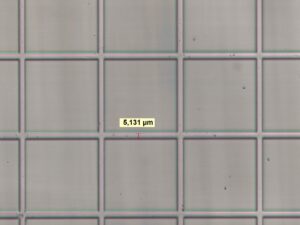
Figure 1. Masking obtained using photolithography
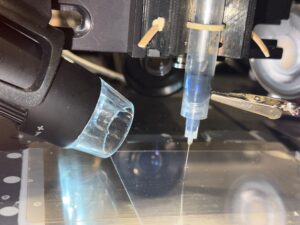
Figure 2. EHD system developed
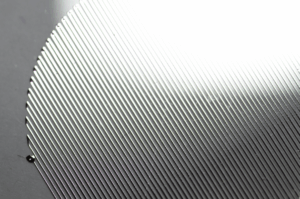
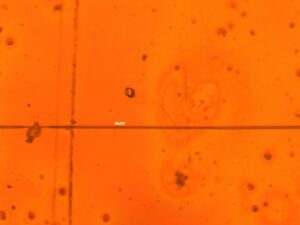
Figure 3. Tracks obtained using the EHD technique on flexible substrates
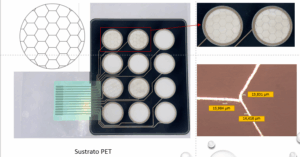
Figure 4. Capacitive keyboard printed using EHD on PET (hexagonal pattern)