3D-MAGNET
Sustainable development of functional 3D materials for mitigating electromagnetic noise
Related links:


Sustainable development of functional 3D materials for mitigating electromagnetic noise
Related links:
Cientific articles
Conference presentations
Magnetic ferrites, primarily used for mitigating electromagnetic noise, belong to the most widely sold kind of magnetic material in the world. One of the primary motors of growth is the automotive industry, which has created a higher ratio of demand for these materials with the sector’s transformation to electric mobility.
Currently, ferrites have simple geometries, they are completely solid, and they are not optimised for the multitude of applications they are used for. On the other hand, they require an enormous amount of energy to produce, and they are extremely heavy compared with the final component. The flexibility of manufacturing that additive 3D printing provides lets us lighten the electronic components/devices created and adapt them to a specific electronic application. Nevertheless, given the lack of commercial products available on the market, new materials must be developed to be able to do it. Furthermore, there is the problem that when the useful life of electronic devices is over a large amount of waste material ends up in waste treatment plants without any specific purpose for reuse.
To solve that problem the 3D-MAGNET project proposes developing 3D printed components that can block noisy electromagnetic signals, based on two key concepts:
Consequently, on the 3D-MAGNET project work has been done on developing 3D printed components that can block noisy electromagnetic signals based on two key concepts: using recycled ferrites from electronic components is disuse, implementing a circular economy, and the ecodesign of the components so they can be 3D printed with specific optimisations of their shape for every specific application with the goal of lightening the components and only using the amount of active material strictly necessary.
One of the main achievements is having incorporated ferrites from disused electronics in a polymer matrix. The ferrites underwent physical grinding processes to achieve that. Suitable grinding conditions to obtain a suitable particle size with the right crystallographic properties were found. In addition, a filament with a high load of those particles that can be 3D printed has been developed.
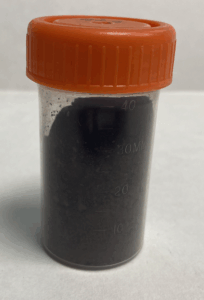 | 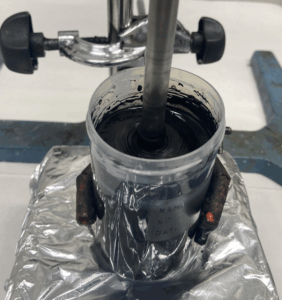 | 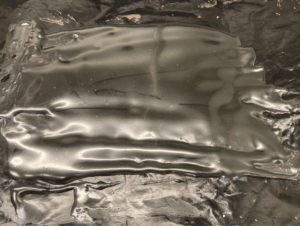 | 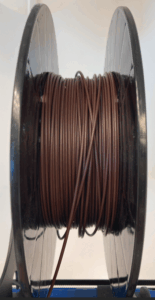 |
| Fig. 1 a) Ferrite dust b) Particles added to the matrix c) Composite d) Filament | |||
During the project, different components have been printed with the various filaments developed, verifying they are suitable for the technology chosen.
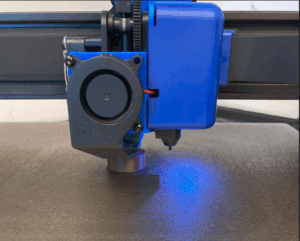 | 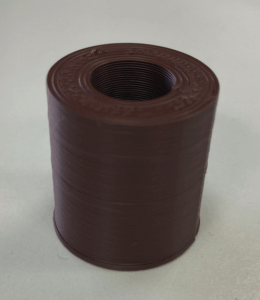 | 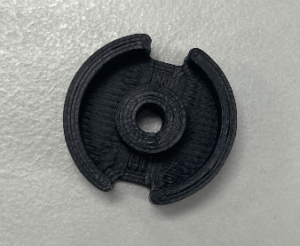 |
| Fig. 2 Filament printing and printed parts with the various formulations | ||
Characterising magnetic materials is very complex. There are multiple methodologies and it usually requires a setup with complex, delicate and very expensive resources. In this project novel work was done on adapting the simplest possible methodologies, especially low-cost ones, to characterise the ferrites and composites developed in the project.
A coaxial transmission line has been designed, simulated and finally fabricated to be able to measure the S-parameters of the printed ferrites.
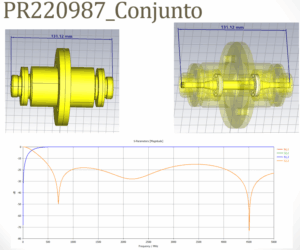 | 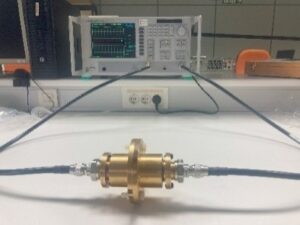 | 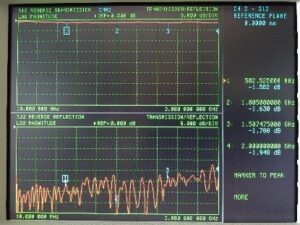 |
| Fig. 3 Design, simulation, and fabrication of the coaxial transmission line |
The real results are close to the simulated ones, with the S11 parameter small enough (low reflection) and S21 big enough (no attenuation so almost the entire signal will reach the device). Both situations are necessary for the kind of characterisation sought.
Furthermore, a part has been developed (printed in negative) to cover the radiant components of a commercial PCB, in order to see the attenuation obtained. The signal recorded was measured using near field probes in three situations: without a shielding element, with a 3D printed element with the filament developed, and with a WÜRTH brand 30410SA6 ferrite sheet.
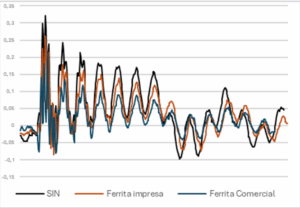
Figure 4. Signal measured with on-circuit near field probes.
An average attenuation was obtained using the 3D printed part.
The project has laid the groundwork for formulations using waste material, to give a new life to ferrites. In addition, it was possible to have a measurement setup for this kind of material, and attenuation in comparison with the commercial ferrites was observed. 3D-Magnet has opened up very interesting and globally cutting-edge new lines of research.