The “Designing Metasurfaces with radiative cooling capacity using AI and surrogate models” (disenIA) project is the natural continuation of the AEVOMETA II project, which was done from September 2022 to November 2024. Passive radiative cooling lets thermal energy be transferred from an object to open space (that is at ~3K) without energy consumption, efficiently radiating in the atmospheric window (8-13 μm) while reflecting solar radiation (0.3-3 μm).
Methodologies and Technical Development
Developing surrogate models to reduce the computing time of multi-layer structures
The project initially explored two main approaches to accelerate the design of multi-layer structures. The first one based on traditional filter theory had significant limitations, especially for band-pass filters that required elements in series that were incompatible with multi-layer structures.
The second approach, based on Bragg reflectors with linear chirp, showed itself to be much more promising. That methodology makes it possible to design multi-layer structures alternating materials with low and high optical contrast where each pair of layers reflects specific wavelengths depending on the Bragg equation. The theoretical results reached net values of ~70 W/m² with temperature reductions up to 7K.
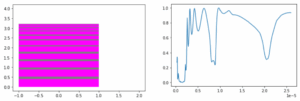
Multi-layer structure with Bragg filters and 0º emissivity curve
Optimising multi-layer structures using evolutionary computation
Evolutionary computation algorithms were implemented to optimise layer thicknesses that significantly surpassed the theoretical Bragg criteria results. The optimal multi-layer structure with 22 layers (SiO2/Si) achieved a net value of 30,098 W/m² with a total height of 2909 nm, which is a 100% increase over the theoretical Bragg solution.
The manufacturing tolerance studies showed the robustness of the design, 94.5% of the structures maintained a net positive value with variations of 15% in thicknesses, and 82% kept values greater than 15 W/m².
Developing Artificial Intelligence Models as Surrogate Models
Direct Design
Deep learning models were developed to predict emissivity curves. GRU (Gated Recurrent Unit) architectures surpassed the conventional CNN1D networks, especially when including physical properties of materials (refraction indices and loss coefficients) as input variables.
The final GRU model, trained with 1,048,576 structures, reached an MSE of 0.000039, where 94% of the predictions had errors less than 0.0001.
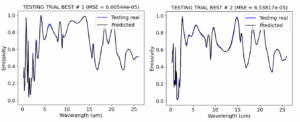
Results of Direct Design with GRU networks
Inverse Design
Dense networks were implemented for predicting structural geometry using emissivity curves. The results showed that 80% of the predictions reached MSE < 1 for layer thicknesses, while 95% obtained > 0.9 accuracy with identifying materials.
Pixelated Metasurfaces to Increase Net Cooling Power
The design of dielectric metasurfaces (SiO2/air) as additional layers to improve absorption in the atmospheric window was researched. The studies showed that configurations with Mie type dielectric resonators made of strategically distributed SiO2 pixels can increase the net power up to an additional 12%.
Nevertheless, it was determined that the priority should be to maintain the high reflectivity of the multi-layer in the solar spectrum, because the losses due to inadequate inclusion of elements on the metasurface can significantly hinder global performance.
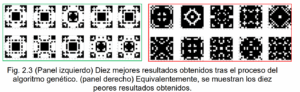
Analysis of Underlying Physics
Using Self-Organizing Map (SOM) techniques and XGBoost algorithms, the most influential variables for the performance of the structures were identified.
Manufacturing and Experimental Validation
Manufacturing processes
The electron beam evaporation deposit process was optimised using SiO2 and Si as base materials for environmental and manufacturability reasons. A deposit process at temperatures below 200º C was developed to minimise the energy impact, and the optical properties were characterised using spectroscopic ellipsometry.
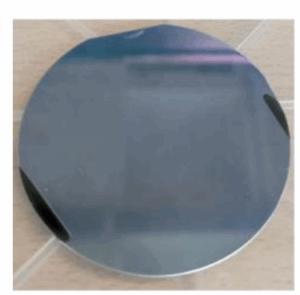
Photo of the manufactured multi-layer structure.
Optical Characterisation
The prototype built had:
- Average reflectivity above 86% in the solar spectrum (0.4-2.5 μm)
- Emissivity greater than 0.92 in the atmospheric window (8-13 μm)
- Null transmittance confirmed in mid-infrared
Exterior Experimental Validation
The experimental measurements in real conditions were:
- Maximum radiative cooling 15.78° C in comparison with reference (09/08/24)
- Nocturnal cooling up to 5º C in comparison with ambient temperature
- Stable operation under variable climatological conditions

Level of Technological Maturity and Transference
The project reached level TRL-5 with a functional demonstration prototype that verifies passive cooling without providing external energy. This technology has significant potential to lower energy consumption in climate control systems, contributing directly to energy transition and environmental sustainability goals.
Publishing and Scientific Impact
The results have been published in high impact journals, including Optics Express and Advanced Photonics Research, and there have been presentations at international conferences (Artificial Intelligence Photonics 2023, METAMATERIALS 2024).